Maps of Makassar City Potential Investments: LQ, Shift-Share, Klassen, and Invest Policy Impacts · Global Voices
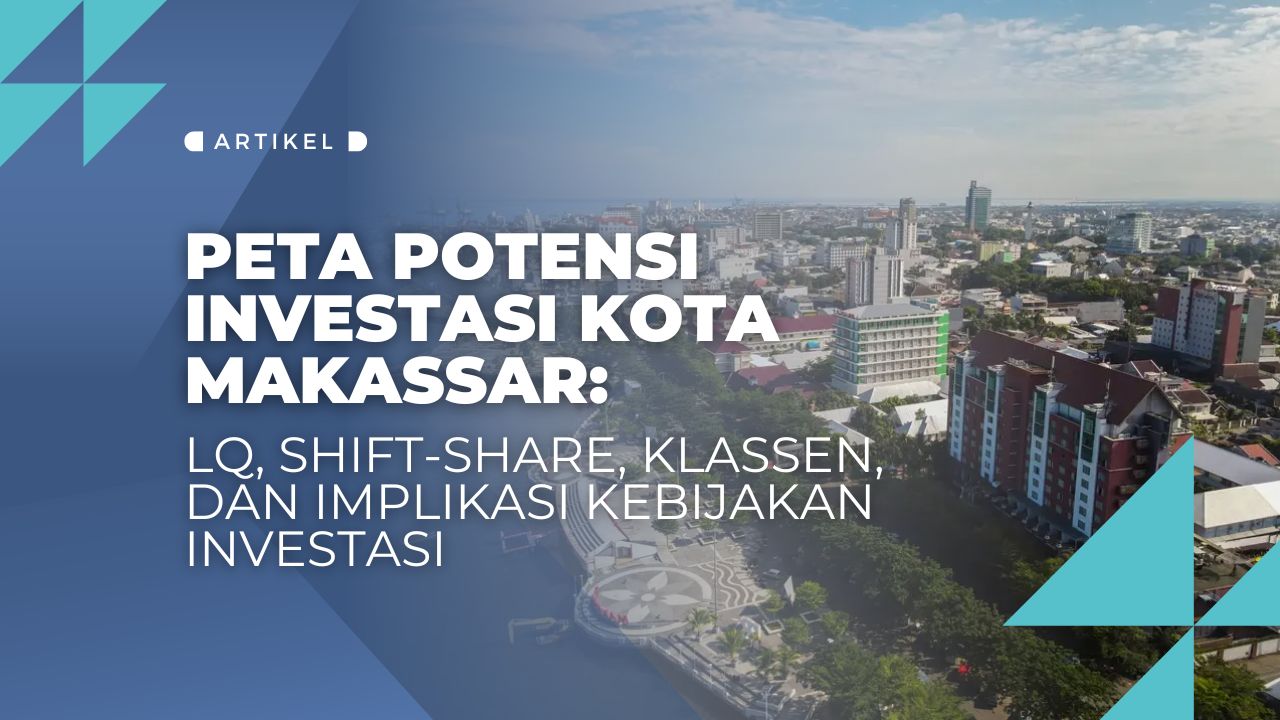
Makassar City as the main port in the eastern region of Indonesia is setting a step towards becoming a more directed investment center. City investment planning requires an analytical framework capable of identifying comparative excellence, growth dynamics, as well as relevant economic structure patterns for infrastructure development policies, logistics and public services. Recent studies indicate that three analytical skeletons Location Quotient (LQ), Shift-Share Analysis (SSA), and Tipology Klassen are often used simultaneously to map the top sectors and priority of policy (classification based on growth and contributions to GDRB) in many major cities of Indonesia and coastal areas. This mapping is important because it can guide the allocation of fical incentives, the ease of permits, as well as cross-OPD collaboration in order to encourage an exclusive and sustainable investment, especially in key sectors such as transportation, maritime, trade, tourism, real estate and industrial development.
Location Quotient (LQ) as an indicator of the city's comparative advantage. Sections with LQ > 1 show a higher city specialty than reference can be made a base for investment expansion. The use of LQ has been used to identify top sectors in Makassar as well as other cities in Indonesia, focusing on trade sectors, accommodations and drinking, as well as professional information and services.
Shift-Share Analysis (SSA) separates the growth contributions of the sector into growing effect and struct / competition effect (city relative performance). The SSA helps direct policy to sectors that show positive dynamics at the city level, even though national trends change, so investments can be focused on logistical facilities, increased CBD capacity, and more efficient trading networks. Tipology Klassen classifies a two-dimensional sector: growth and contribution to PDRB. Sectors on the I (advanced) and III (progress) become a major focus for investment priorities, while the Il / IV quadrant indicates the need for structural intervention to move to a higher quadrant.
One of the superior sectors and potential areas. The leading sector is the Processing Industry; Accommodation and Drinking; Transport and Storage; Commerce; Real Estate; Parish. While the city's focus: North for logistics and new cities; Central for CBD and commerce; West Coast for inheritance and harbor; South for property and recreation. This skeleton is consistent with the potential LQ / SSA / Klassen which shows the concentration of activity in service sectors, infrastructure and service related tourism and logistics in coastal cities.
The consistent quality of Makassar comes through a combination of LQ / SSA / Klassen, Processing Industries, Accommodation and Drinking, Transport and Sales, Commerce, Real Estate, and Parish. The framework shows that coastal cities that pose as logistics will benefit from TOD and logistical infrastructure reinforcement, including pier revitalization such as Lanyukang, Caddi Barrang, Buloa, and Jeneotar Vest. The unified tourism undermines the potential of Heritation and Bahari with tourism, eco-resort, and recreational packages. CBD and trade were enriched through increased retail capacity, professional services, and incentive to permit. Real Estate will grow in line with adequate regulation and public infrastructure to mobilize investment currents. The main challenge remains related to bureaucratic barriers and legal certainty that requires government cross-level coordination as well as the investment council commitment to simplify the permit procedure and increase the transparency of investment data.
Conceptual supporting data: regional literature and other city studies show that service sectors, infrastructure, trade and logistics tend to be the main thrusters of investment in coastal cities and metropolitan. The example of Surabaya studies and Eastern Kalimantan show how LQ / SSA / Klassen can direct investments in the transportation sector, accommodation, information, and corporate services, and how the management policy and investment promotion can accelerate project realization. The comparison analysis between Makassar and other cities also shows the nuances of results due to data periods, region references, and different sector definitions, so that the updates of data become important. So, a map of Makessar City's potential investments built through a combination of LQ, SSA, and Klassen provide a strong analytical framework to identify the superior sectors and potential areas. Six major sectors of the Processing Industry; Accommodation and Drinking; Transport and Warehouse; Commerce; Real Estate; Tourism is potentially a growth driving motor if supported by an easy investment policy, proper fictional incentives, and OPD cross coordination through the Investment Council. Focus on designated areas (North, Central, West, South) support consistent efforts to optimize TOD, port, and unified tourism destinations. The national bureaucracy challenge still needs to be handled through policy advocacy and transparency data. Thus, Makassar has a chance of becoming an exclusive metropolitan, competitive, and able to draw inves.
Author: Conceptual supporting data: regional literature and other city studies show that service sectors, infrastructure, trade and logistics tend to be the main thrusters of investment in coastal cities and metropolitan. The example of Surabaya studies and Eastern Kalimantan show how LQ / SSA / Klassen can direct investments in the transportation sector, accommodation, information, and corporate services, and how the management policy and investment promotion can accelerate project realization. The comparison analysis between Makassar and other cities also shows the nuances of results due to data periods, region references, and different sector definitions, so that the updates of data become important. So, a map of Makessar City's potential investments built through a combination of LQ, SSA, and Klassen provide a strong analytical framework to identify the superior sectors and potential areas. Six major sectors of the Processing Industry; Accommodation and Drinking; Transport and Warehouse; Commerce; Real Estate; Tourism is potentially a growth driving motor if supported by an easy investment policy, proper fictional incentives, and OPD cross coordination through the Investment Council. Focus on designated areas (North, Central, West, South) support consistent efforts to optimize TOD, port, and unified tourism destinations. The national bureaucracy challenge still needs to be handled through policy advocacy and transparency data. Thus, Makassar has a chance of becoming an exclusive metropolitan, competitive, and able to draw inves. (Indonesian CPDS researcher)