Sumatra Forest Deforestation: Government failure in Sumatra environment management · Global Voices
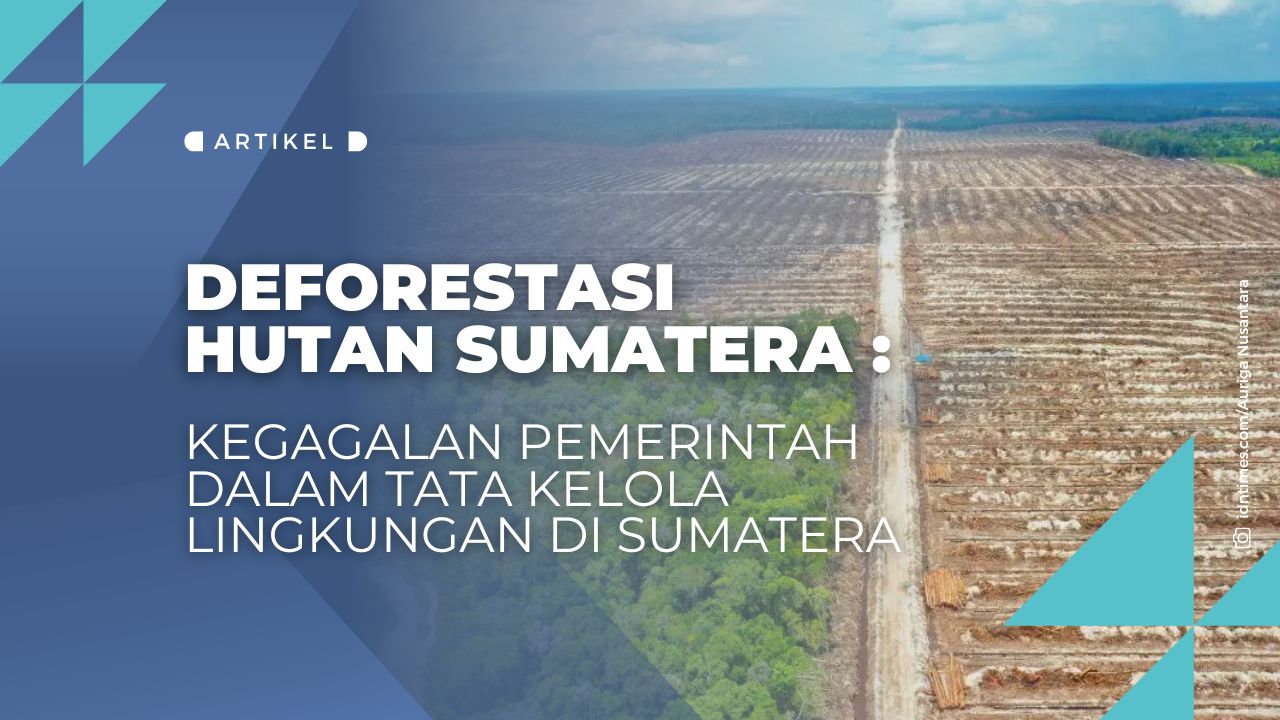
The disappearance of the forest in Sumatra is not the result of an ecological disaster. The disaster was an accumulation of government policy, bureaucratic practice, and state accountability in managing such resources. For a decade (1994-2024), based on Analysis Team Data Compass Journalism reveals, the disappearance of forests in Aceh, Northern Sumatra, and the average of 36.305 acres per year. If we convert it per day, we find the number of 99.46 acres missing per day. This number is equivalent to the disappearance of 139 football fields a day. As for the size of a football field, it's 7.140 square meters, according to FIFA standards. 2024 reduced to 8.26 million acres. The maximum forest breach is in Sumut, which is 50,404 acres. As for the deforestation of the forest at Abah 379,309 acres and Sumbar 354,651 acres. Sumatra Island became the center of forest deforestation due to the expansion of palm fields, mining areas, and industrial plant forests.
Flood and landslide hit three provinces on Sumatra Island, which is Aceh, northern Sumatra, and Western Sumatra, in late November 2025. This disaster was not only triggered by a Sellard Cyclone phenomenon that led to a very heavy and unusual rain, but by human nature. The flood and the avalanche carrying the log didn't come from the clouds, it was due to the massive forest of humans. This is the most real consequence of deformity. This disaster also shows that the poor environmental management and political decisions are only in the business of a group of people causing harm to society especially during the climate crisis of Indonesia. Chester HartA threat of natural disasters such as storms, earthquakes, or tsunamis become catastrophic only if society is not protected. Thousands of lives died and hundreds of people went missing not just because of weather, but because of political and environmental decisions that put citizens in danger.
In the governance framework, bureaucratic reform should produce professional, transparent bureaucracy, and responsible for public interest, including environmental protection. However, reality in the field shows a gap between reform and bureaucratic practice. The state is present through regulation and institutions, but less in scrutiny and accountability when the forest continues to decrease its capacity. The bureaucratic reform in Indonesia is basically aimed at increasing state apparatus performance through institutional justification, simplification of procedure, and accountability. In the forest sector, this reform is expected to improve the licensing system, suppress the corruption practices of natural resources, and reduce conflict between government, corporations and communities. However, in its establishment, bureaucratic reform often stops at administrative and symbolic changes, such as drafting standard operational procedures, digitization of services, and performance reporting. That change has not yet been followed by a real step that truly protects the forest and keeps the ecosystem sustainable. In fact, public policy should be designed to create a more fair, safe and prosperous social life. In public administration view, policy is not just a bureaucratic tool or a formality of reform program, but a means of improving the quality of society (Nugroho, 2023).
The failure of environmental policy in Sumatra shows weak ethics in public administration practices. Many decisions were made by prioritizing short-term economic profits or major corporate interests, without considering long-term impact on society and the environment. In many cases, local authorities and civil apparatus of the state have already worsened the conditions due to the lack of scrutiny, there is a conflict of interest, as well as potential corruption in the process of decision making (Nugroho, 2023). When the forest opening permit is given without adequate risk studies, the government has basically derailed the moral responsibility to protect its citizens.
Most deforestations in Indonesia occur because of governance and weak law enforcement. In fact, the areas of the forest that should have been protected by the state had suffered illegal logging and opening of forests without the firm measures of the government, so forest destruction continues. When civil society criticizes these conditions, the government tends to weaken the rules regarding land usage, not uphold existing rules. As a result, companies and individuals with economic and political powers remain untouched by the law and continue to conduct environmental destructive practices, despite the rules.
With the government's inconsistencies in taking up policy, the lack of surveillance and performance accountability, the deformity of forests in Sumatra reflects the failure of governance in the environment. It can't be solved through a technical or sectoral approach, but through a restudy of bureaucratic reform as an attempt to build an ecologically responsible bureaucracy. The performance accountability needs to expand until it covers the policy impact on the environment so that the state actually runs its constitutional trust in managing natural resources to make the most of its benefits to the people.
Reference
1. https: / / www.compas.id / article / forest -sumatera - vanished
2. https: / / items.ssrc.org / understanding-katerina / theres -no -such-thing -as -a -natural-disaster /
3. https: / / ejourna.seaninstitute.or.id / index.php / essay / article / view / 2248 / 1947
4. https: / / eyesontheforest.or.id / backgrounders / lack
5. https: / / www.instagram.com / p / DR6vLXE27y /? img _ index = 2 & igsh = dXpsN3Z6ODZ2d3ox
6. https: / / www.compatian.com / vanesriwedday 0860 / 693728888888884153744444444452f0c3 / failure
Seven. Nugroho, R. (2023). Public Policy 7: Public policy dynamics, public policy analysis, public policy political management, political ethics. Elex Media Computindo.
Author: Mauldya Maghfiro, S.SI, M.Stat. (Indonesian CPDS researcher)