

Translations of Security and Public Order in the Digital Era: Technology Role In Performing Adaptive Public Safety · Global Voices
Public security and order is one of the basic needs of society that determines the quality of life, social stability, and sustainability of development. In the last two decades, the development of digital technology has changed many aspects of life, including the way governments and security forces maintain public order. If in the past the security effort tends to be reactive, that the apparatus moves after what's happened, then technological development drives paradigm into more adaptive, predictive, and integrated systems. In other words, the security in the digital age demands the ability of the authorities and governments to understand the threat faster and take action based on data and real-time information.
Indonesia is not separated from the dynamics. The rapid digitalization rate, the use of smartphone is almost evenly equal, as well as the increasing interactions of the people in digital space provide opportunities but it also presents new challenges. Public security is now two-dimensional: physical and digital. On the one hand, conventional threats like vehicle theft, violence, and public order disorder are still occurring. On the other hand, multiple forms of cybercrime began to dominate, like online fraud, data breaking, identity theft, to the spread of hooks that could trigger social conflict. Data according to cyber patrol in 2025 recorded a significant increase in cyber crime reports, especially digital fraud associated with online transactions. This phenomenon shows that security is no longer just placed on streets or public spaces, but also in devices used daily.
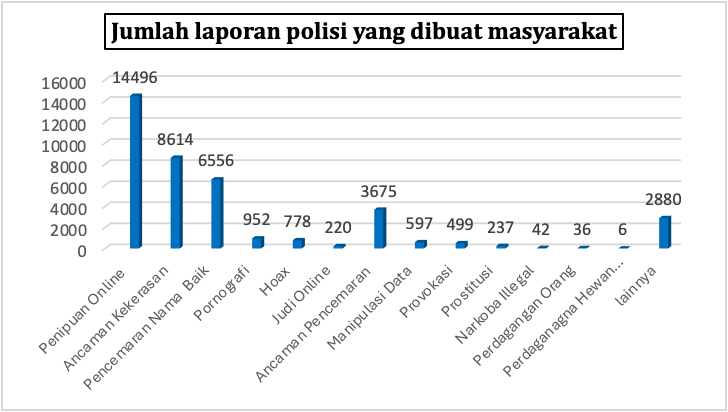
SNumber: https: / / Patroliciber.id / statistic /
It was this change that led to technological innovation in the public security sector. Many cities in Indonesia began to develop concepts smart city Which one of the components is smart surveillance. The city of Surabaya and Bandung, for example, has built a control center (command center) connected to thousands of CCTV points in various public spaces. This technology is not just recording, it's also analyzing certain activities using artificial intelligence. Cameras can detect massive crowds, suspicious behavior, up to automatic traffic violations. According to research, 2024 Susilo and Dkk., Smart CCTV applications can lower the number of criminality in public areas because early detection prevents events from developing any further. Even an officer can respond faster because the CCTV information is directly connected to the control center.
In addition to the surveillance system, big data analytics became a vital tool in the approach to modern public security. Every report that comes in from society, every crime scene recorded, to the digital mobility pattern to map the vulnerable area. This approach allows police authorities to no longer work based on mere intuition, but based on data that can be accounted for. The use of data analysis can increase the efficiency of police patrols and reduce crime rates in certain areas because personnel placement becomes more targeted. Concept predictive policing like this not only increases the effectiveness of handling but also drives the use of more efficient resources.
Technology also allows communication between society and the security authorities. Various digital reporting applications have been developed both local and national, such as Jogo Suroboyo application, as well as the panic button used in some cities. Through this application, citizens can report events quickly by including photos, locations and short descriptions. This model shortens communication chains so that the authorities' response time is shorter. It shows that digital reporting features increase community participation in security, especially in urban areas with high levels of mobility. Citizens no longer have to come to the police station or call the hotline; enough with a click on smartphone, reports can be received by the authorities.
In addition, the Internet of Things provides significant support for public safety, especially in the field of hatred. Indonesia is a nation vulnerable to disasters like earthquakes, floods, and landslides. Therefore, the application of digital sensors to monitor the natural conditions becomes very important. The flood sensors, for example, can detect the rising surface of water and send an early warning. Air quality sensors are used to monitor the pollution and potential land fires. Rizki Mimbah Hydayat, (2024) found that the use of the early warning system is loT-based can increase community readiness and accelerate response when the threat is catastrophic. A system like this helps the government reduce lives and material losses.
However, the use of technology in public security is not at risk and challenge. One of the biggest problems is potential invasion of privacy. The use of camera with facial recognition technology raises the question of yankni ethics as far as the state is entitled to monitor its citizens then what if the data collected was abused. Without clear rules, security technology can turn into an excessive control tool. This concern is increasingly relevant considering some of the data leaks occurred in Indonesia. The latest reports of the Cyber Agency and the State Password (BSSN) reveal that the threat of the 2025 BSSN is getting serious, cyber attacks against government agencies are increasing over the years. Digital attacks are now no longer just stealing data, but directly targeting financial losses and business reputations. Starting from the 2025 ransomware that paralyzes bank operations, to the Al-based social engineering that cheats employees with deephax voice mode, this trend confirms the fragility of national digital financial ecosystem. If the data security system is not reinforced, then the CCTV data or digital reports that should protect society can be a threat (IT GOVERNANCE Indonesia, 2025).
Besides privacy issues, digital gaps become another challenge. High-tech security is easier to apply in large cities that have adequate budgets and infrastructure. Meanwhile, many areas outside Java or rural areas don't yet have stable Internet networks or adequate digital devices. As a result, digital security services are uneven and causing inequality in public security access. This challenge should be taken care of because security is the right of all citizens, not just those who live in the city. The other problem is the capacity of human resources. Officials and local governments need to have digital skills to manage this new technology. Without adequate training, advanced technology will not be used optimal. Many areas claim that digital security systems have been purchased but not utilized due to lack of technical training. It's in line with the BSSN findings that says that the primary weakness in the digital security system is an SDM factor, not just technology.
Looking at those opportunities and the challenges, strategic measures need to be done to ensure that technology actually helps improve public security. The government has to build transparent and accountable data management. Personal data protection regulations must be enforced to use technology not to inflict abuse. Admittance collaboration needs to be reinforced. His ideal digital security system connects Polri, local government, cominfo, BPBD, and BSSN in one integrated information network, digital literacy society must be increased. Many cases of online fraud occur due to the low understanding of the public's digital risk. The government has to make sure that the organisation of technology to keep the areas far from downtown can also enjoy equal security services. Last evaluation periodically for the use of technology needs to be done to make sure technology goes effectively and doesn't cause new problems.
Ultimately, the transformation of security in the digital era wasn't just about buying a device or installing a camera. What's important is how the technology is used, managed and watched. Technology is just a tool; the success of keeping security depends on quality of policy, authority readiness, and community participation. If all three go together, then technology can create more adaptive, responsive, and according to the needs of the age. However, if only relying on technology without good management, digital transformation can only add new vulnerabilities to the public security system. Security in the digital age requires a balance between technology effectiveness and the basic rights protection of citizens. With a careful and measurable approach, technology can be an important factor in creating more secure, orderly and human public space. This transformation is not only about modernization of the system, it's also about building public belief that the state is present and is able to protect its citizens in the midst of the change of time.
Reference
IT GOVERNANCE Indonesia. _.
Cyber patrol. (2025). The number of cyber crimes reported by the Society. Republic of Indonesia Police.
Rizki Misbah Hidayat. (2024). The effects of LOT Technology on Smart Mobility in Smart City Context: Jupiter: Publishing Industrial Technology, Electro Engineering and Information · Global Voices, 3(1), 01–08. https: / / doi.org / 10.61132 / jumpiter.v3i1.640 Susilo, B., Mardianto, G. D., & Aldilaga, D. (2024). Implementation Closed Circuit Television (CCTV) as a Security System in the Department of Applemental Education of Poor State University. Science Education: Journal Theory and Practice of Education · Global Voices, 9(2), 84–90. https: / / doi.org / 10.17977 / um027v9i22024p84-90
Author: Reza Eka Lestari, S.AP. (Indonesian CPDS researcher)