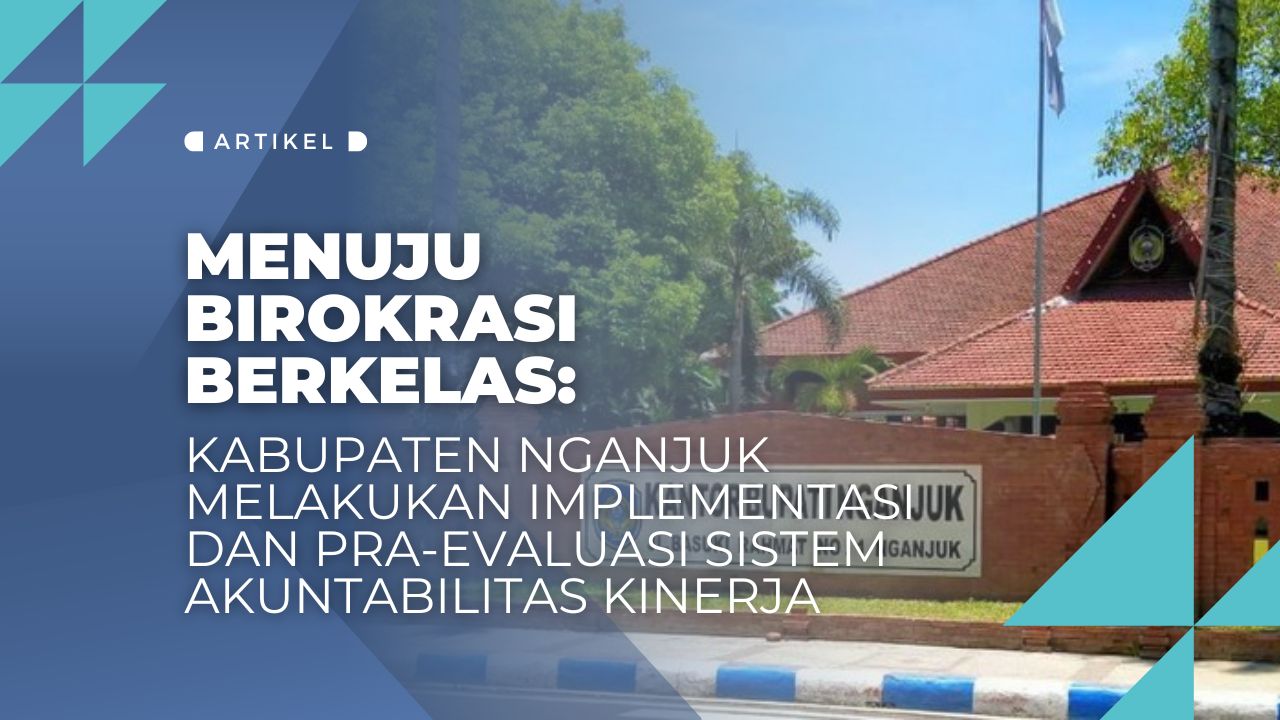
Go to Clash Bubration: Ngansuk Regency Perform Implementation and Pre-Evaluation Performity System
The effort to improve the quality of governance continues to be the focus of the Nganjuk District Government. One strategic step is to strengthen the implementation of the Govt Agency's Performity System through various activities of coaching, funding, and pre-evaluation of local devices. This move is expected to drive the creation of a more effective, efficient and oriented bureaucracy to results.
According to President (Press) 2014, the 2014 29th Rule Accountability System (SACIP) is a systematic sequence of activities, tools, and procedures designed for the purposes of suppression and measurements, data collection, classification, initiation, and performance reporting for government agencies, in order to take responsibility and improve government agencies. SACIP project covering: 1) strategic plan; 2) performance agreement; 3) performance measurement; 4) performance data management management; 5) reporting performance; and 6) reviuw and performance evaluation. In this press, SaKIP is not only focusing on drafting administrative documents, but also focusing on manifesting good governance and clean government, improve the accountability and transparency of government agencies, creating a system that prevents corruption and collusion from happening, increases performance and outcome Government agencies, as well as increasing public accountability and transparency (Hermawan, 2026). This is required by the government agency to publish information about its performance to the public and provide the people with access to the decision-making process in the local government agency (Hermawan, 2026).
One of the most important stages in the SAKIP reinforcement is pre-evaluation implementation. This event aims to get a general image of the government / working agency to be evaluated (Ministry of PANRB, 2021). Through pre-evaluation, various weaknesses and constraints can be identified earlier so that repairs can be done before the execution of an official evaluation. According to Mahmudi (2015), performance measurement is a tool to assess organized success. In the context of the organization's public sector, that organization's success will be used to gain legitimacy and public support. Thus, preevaluation can be an instrument to improve performance management qualities.
In the Nganjuk District, pre-evaluation implementation can become a momentum to strengthen the coordination between local devices. With a joint evaluation forum and discussion, each working unit can share experiences, good practices, and solutions to various challenges faced in the performance management of the public sector. According to the Open Data District of Nganjuk (2025), the Nganjuk District SACIP score shows the value 70.19 with the BB Indicator (Very Good). The Nganjuk district also got the state government's Evaluation Evaluation value at 3,5409 that got the high category (Open Nanjuk District, 2025). Overall, the SACIP and the EPPD have shown that the Nanjuk District has had a strong foundation for creating an accountable, effective, and oriented government. Therefore, pre-evaluation implementation becomes a strategic momentum to maintain and improve the quality of governance through strengthening the coordination between local devices, the distribution of good practices, and the completion of the obstacles that are still facing in the management and management of the state government. The Nganjuk County government expects an increase in the implementation of more synergistic and directional programs. Harmonic between planning documents, budgeting, implementation and reporting are essential to achieving planned development goals (Jiwayanti et al, 2024).
The extension of human resource competence is a critical factor in the success of the implementation of the Government Agency. The State Civil Inspector needs to have an adequate understanding of the drafting of performance indicators, measurement, data analysis, to the drafting of accountability reports. Therefore, training and mentorship need to be continued in order to increase ASN capacity in favor of reinforcing performance accountability. The reinforcement of the accountability is in line with a national bureaucratic reform agenda which emphasizes its clean, effective, and oriented bureaucracy. Accountability is the sole purpose of reforming the public sector, where public accountability demands that public sector agencies not only emphasize vertical accountability, but also horizontal accountability to society. In the context of the Nganjuk District BPKAD, employee performance accountability is manifested through the SACIP application which includes reporting agency performance and use of e- performance as a means of reporting individual employee performance. The system's application shows accountability because it's based on verifiable concrete and data.
Successful implementation and pre-SAKIP evaluations in the Nganjuk district are expected not only to affect the value of the local government's performance evaluation, but to also be able to encourage the presence of its transparent, professional, and responsive government. Thus, any development program can give optimal benefits and support the acceleration of the development goal of the area.
Author: Mauldya Maghfiro, S.SI, M.Stat. (Indonesian CPDS researcher)
Library List
Hermawan. (2026). Public Service Accountability. Brawijaya Press University.
Jiwayanti, N., Abror, D., Pramono, T., Magister, P. & Public, A. (2024). Oversight of Regional Personnel Perfortional Activity via Audit Internal Perforcement Government Perspectors (APIP). In Interaction Journal (Vol. 01, Number 01).
The PANRB Ministry. PANRB's Rule Number 88 Year 2021 About Evaluation of Government Accountability Accountability.
Mahmudi. (2015). Public Sector Perforcement Management. Yogyakarta Press.
Mardiasmo. (2021). Public Sector Accounting. Andi.
Open Data District Nganjuk. (2025). SACIP score 2025. Https://Ckan.Nganjukkab.Go.Id/Uk/Dataset/Sakip-Tahun-2025/Resource/B2c2209b-1150-4ab8-Acf4-2b93e98d1675 . https://ckan.nganjukkab.go.id/uk/dataset/sakip-tahun-2025/resource/b2c2209b-1150-4ab8-acf4-2b93e98d1675
Open data Kabupaten Nganjuk. (2025). Skor Sistem Akuntabilitas Kinerja Instansi Pemerintah SAKIP. Https://Ckan.Nganjukkab.Go.Id/Hu/Dataset/Skor-Sistem-Akuntabilitas-Kinerja-Instansi-Pemerintah-Sakip–b-Tahun-2025 . https://ckan.nganjukkab.go.id/hu/dataset/skor-sistem-akuntabilitas-kinerja-instansi-pemerintah-sakip–b-tahun-2025
Peraturan Presiden Republik Indonesia No. 29. (2014). Sistem Akuntabilitas Kinerja Instansi Pemerintah.Wahyuningtyas, D. A. (2024). Evaluasi Kinerja Pegawai Badan Pengelolaan Keuangan dan Aset Daerah (BPKAD) Tahun 2022 di Kabupaten Nganjuk. Interaction Journal, 1(3). https://ojs.unik-kediri.ac.id/index.php/interaksi/article/download/5921/3706