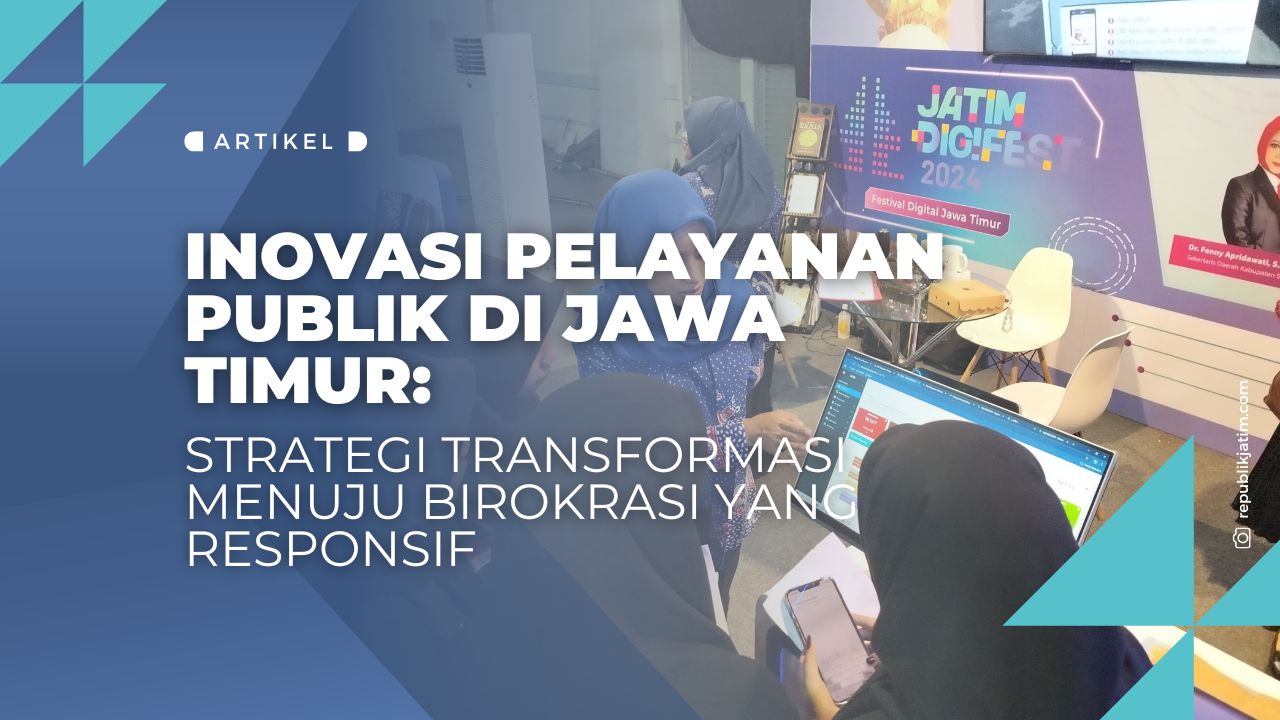
Public Service Innovation in East Java: Transformation Strategy To Responsive Biographical · Global Voices
Public service is one of the main functions of the government that comes directly into contact with people's lives. The quality of public service becomes a real mirror of the country's bureaucratic capacity in carrying out its duties. In the digitization era and bureaucratic reform demands, innovation became inevitable inevitability. The 2009 25-Year Act of Public Services has been emphatically able that public service management should be done in transparent, accountable, and oriented to service-user satisfaction. This becomes the foundation for the local government, including the Eastern Java Province, to continue to innovate in providing the best service to society. East Java as one of Indonesia's largest provinces with a population of over 40 million people facing the complexity of the challenges in the preservation of public services. The diversity of areas made up of urban, rural, to islands like Madura demands an adaptive and exclusive innovative approach. The Eastern Java Province Government has responded to this challenge with a wide variety of policy breakthroughs that are encouraging the application of innovation in every public service line.
The innovation of public service in East Java is supported by a powerful regulatory framework. In addition to the 25th Year of 2009, Government Rule Number 96 of the Year 2012 on Public Service Enforcement Enforcement Enhanced the local government's obligation to establish a measured and sustainable service standard. Based on that basis, the Eastern Java Province Government publishes various derivative regulations that drive digital transformation and bureaucratic modernization at the district / city level. One of the top Eastern Java innovations was the MPP Service Mal program that integrated hundreds of types of government services in one roof. The MPP that was first launched in Surabaya was then replicated in various districts of East Java. According to S.H.I.E.L.D. (2011) in his examination of public service management, one-stop service approach such as MPP proved significantly increasing the efficiency of service time and reducing potential for corruption and wild levers. This innovation was able to cut the administration's time which previously requires a visit to many agencies to be quite a location.
Digital transformation became the main pillar of public service innovation in East Java. East Java Super Corridor Platforms and digital-based applications developed to reach communities all over East Java. Sinammatdkk. (2014) asserts that information-based innovation in public services is not just about efficiency, but also about the increase in services for communities who have been geographically marginalized. In the context of East Java, digitization of occupational services, health and business permits through online systems has made a real impact on the alignment of public service access. In health, the innovation of East Java public services is manifested through a healthy system that integrate public health data realistically. In the education sector, a new education registration platform (PPDB) online has replaced a manipulative manual system. While in the field of licensing, the OSS System (Online Single Submission) integrated with local systems successfully simplifies the process of business permit from which it takes decades to count days or hours. These successes put East Java consistently on the list of provinces with the best innovation index in recent years.
Nevertheless, the application of public service innovation in East Java is not without challenge. The digital gap between urban and rural areas is still a serious obstacle. The survey Hardiyansyah (2018) did about the quality of public service in Indonesia found that digital infrastructure inequality led to the benefits of technological innovation has yet to be felt evenly by the entire layer of society, especially in remote areas. In addition, the capacity of human resources for civilian apparatus countries (ASN) in managing modern innovation systems still requires significant improvement. The application of public service innovation in East Java reflects the seriousness of the local government in fulfilling the trust of the Public Services Act in concrete and measurable. Miscellaneous breakthroughs such as Mal Public Services, digitization of administrative services, and integration of local information systems have changed the face of Eastern Java's bureaucracy into more responsive and oriented community needs. This success needs to be maintained through consistent budget commitments, sustainable ASN capacity development, as well as the alignment of digital infrastructure into the area. Thus, the innovation of public service is not only a momentary achievement, but a sturdy foundation for the creation of good government and quality service for the entire Eastern Java society.
Library List
Peliyanto, A. (2011). Restoring public trust through bureaucratic reform. Jakarta: PT Gramedia Main Library.
Hardiyansyah. (2018). Public service quality: concept, dimension, indicator and implementation. Yogyakarta, Gava Media.
Sinammatam, L. P., dkk. Public service reform: theory, policy, and implementation. Jakarta:
Indonesian Republic Act Number 25 Year 2009 about Public Services. Indonesian Government Rule Number 96, 2012 about Public Services Act 25, 2009 About Public Services.
Author: Dhefara hersaning ditaa, S.APA. (Indonesian CPDS researcher)