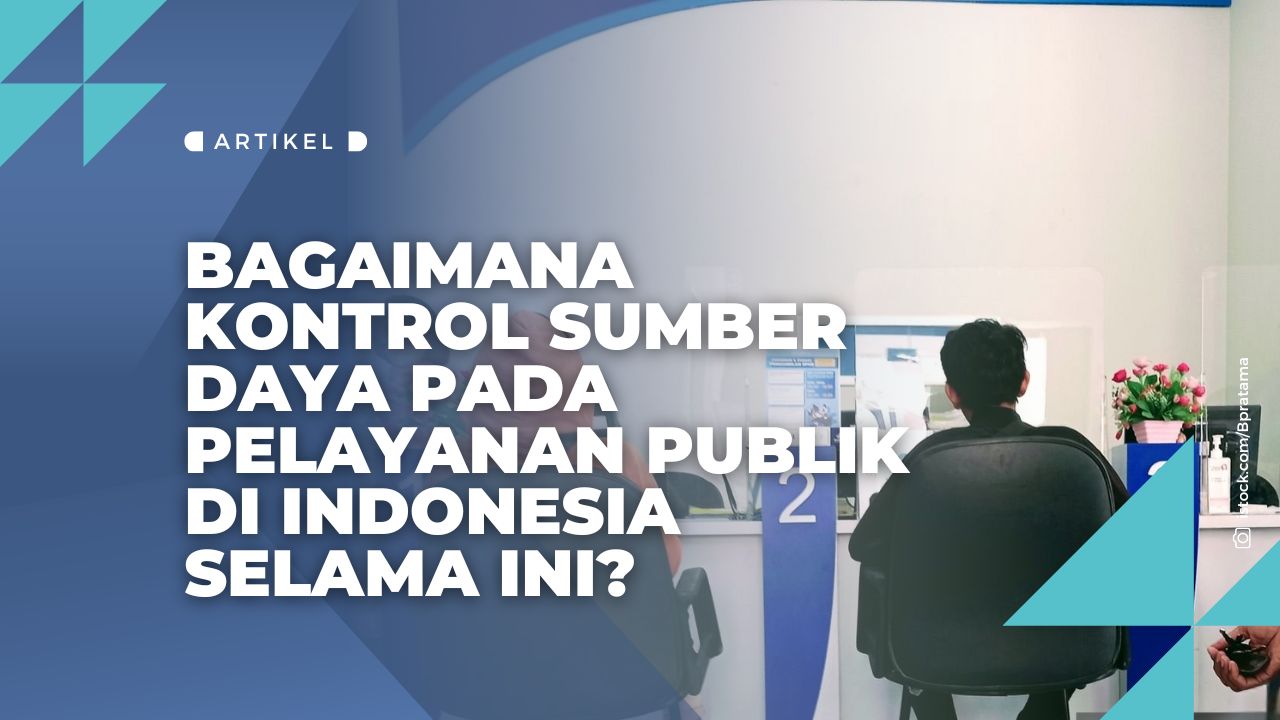
How's Resource Control at Public Services in Indonesia?
Have you ever wondered how the ASN quality in public services in Indonesia today? Has it fulfilled the expectations of society? Is there a certain method of control for ASN?
That question is common to society because as a public servant, ASN is expected to provide the most service possible. So far, control over human resources, procedure, agitation of infrastructure, and performance measurement mechanisms becomes the key to making public service work effective and accountable.
The control of resources in public services includes some important elements: ASN management, measuring service performance, allocation and budget usage, infrastructure and technology utilization. The central government has set various regulations, such as the 2009 25-Year Act of Public Services and State Enforcement and Reform Biocracy Number 14 of 2017 (PANRB Candy 14 / 2017) about the guidelines of the Public Comfort Survey, to strengthen that control mechanism.
This control Urgension is getting bigger in the era of decentralization and autonomy of the region, where many public services are held by units in the area through a one-door service system which is normally implemented by DMPTSP (MPTSP). Therefore, control is not only about running a service, but also monitoring quality, effectiveness, and the impact of services on society.
ASN as public service main executioner must have competence, integrity, and orientation served. The central government through the SaKIP mechanism requires the government's performance agencies to plan performance, indicators, monitoring, and reporting progress. As such, ASN and public service units are not only "doing tasks" but also "measured performance." In addition, survey of public satisfaction (ICM / SKM) becomes one of the external measuring points against public perception of service. With data from the survey data, governments and areas can see as far as public services are received and felt by the public.
But in practice, there is still a challenge like: ASN that doesn't yet have adequate digital competence, an extremely complex service procedure, inadequate infrastructure, as well as interstate disparity in service performance.
For example, the KM Index in Eastern Java Province is based on the 26th-year-of-the-year-of-the-year 2021 Peace Enforcement Survey Unit. ClM survey results over the last 4 years tend to have an increase. It proves that society is getting more and more satisfied with the services that the government gives you when the government is constantly furnished. Especially on the public side of public service that directly presents itself with society. All this shows is that if governments are constantly righteous and planning, then people will feel their benefits in the form of satisfaction they receive. The government is responsive to public needs and complaints, as well as committed to continuing to improve quality of service, will gain the confidence and support of citizens.
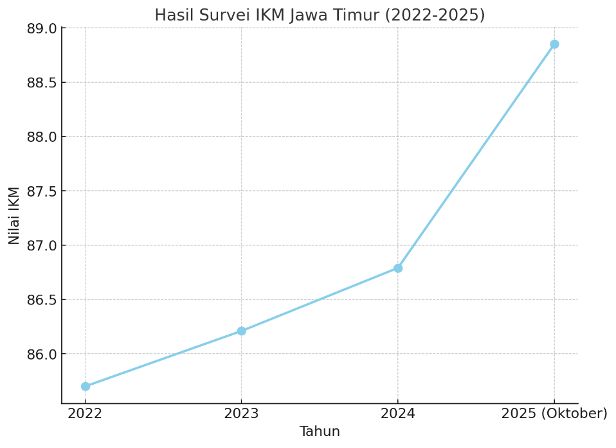
Source: Produced Author (2025)
According to that data, it's important for the government to not only view survey results like ICM as a mere indicator, but also as a reference to continuing to do repairs in various aspects of public service. All parties in the government, both at the center and in the area, have to work together to look after and improve these qualities in order to further reflect the needs and expectations of the continued society.
Some reason for control related to Human Resources in Government:
- Why is control important: Without proper control over resources (ASN, budget, procedure, means), public services are easily inefficient, unresponsive, and unaccountable. The lKM survey provided an important signal—If the public feels bad service, then the control of the resources in the service unit should be evaluated.
- How the controls run: The central government sets regulatory and guidelines, such as PanamrB Candy 14 / 2017, requiring public service units to survey public satisfaction as part of a performance monitoring. The region then applied a routine lKM survey for PTSP units. ICM data is then used as an evaluation material, reinforcing ASN capacity, repair tools / infrastructure, and simplification of service procedures.
So, what does the government have to do?
- ASN capacity reinforcement: Continuous training particularly in digitization of service, complaint management, and public service orientation. The ASN competition became central so that control was not just regulation but effective execution.
- Service procedure simplification: PTSP units must continue to reform service flow, reducing complex bureaucracy, accelerating completion time. ClM data shows that the completion time is still a weakness in several units.
- Utilizing technology and monitoring systemsThe integration of the digital system (dashboard service, e xtSP, e etc. so that control can be done in real time.
- Increasing transparency and accountability: Open survey publication of klM survey, easy and responsive filing mechanism, and feedback from society becomes part of external control.
- Comprehensive performance indicator: Not only measure global gratification, but also aspect of operational aspect (time, cost, means, complaint). This indicator must be put into the ASN / unit performance agreement.
- Performance-based budget(Laughter): The PTSP unit budget must be related to the performance of service and lKM performance.
- Periodic regulatory evaluation and updates(digital divide, public expectations, pandemic, ASN hybrid work).
When we ask about ASN quality and control resources in public service, we're actually asking: is our system quite perceptive, fair and efficient to present decent public services to all citizens? The lKM survey shows that many units have made progress, but there's still plenty of room for improvement—Especially in aspect of process and resource capacity. If Indonesia wants to take public service as an illusion and justice machine, then control over human resources, technology, budget, and process should be viewed as a priority cannot be delayed.
If you want to know more about how management should be done by the public sector in optimization of its resources and services, read the full material in the "Public Sector Management" book published by CPDS, completely in https: / / ykpp.cpds.co.id / management -sector -public /
Author: Dhefara Hersaning Ditau, S.APA. (Indonesian CPDS researcher)